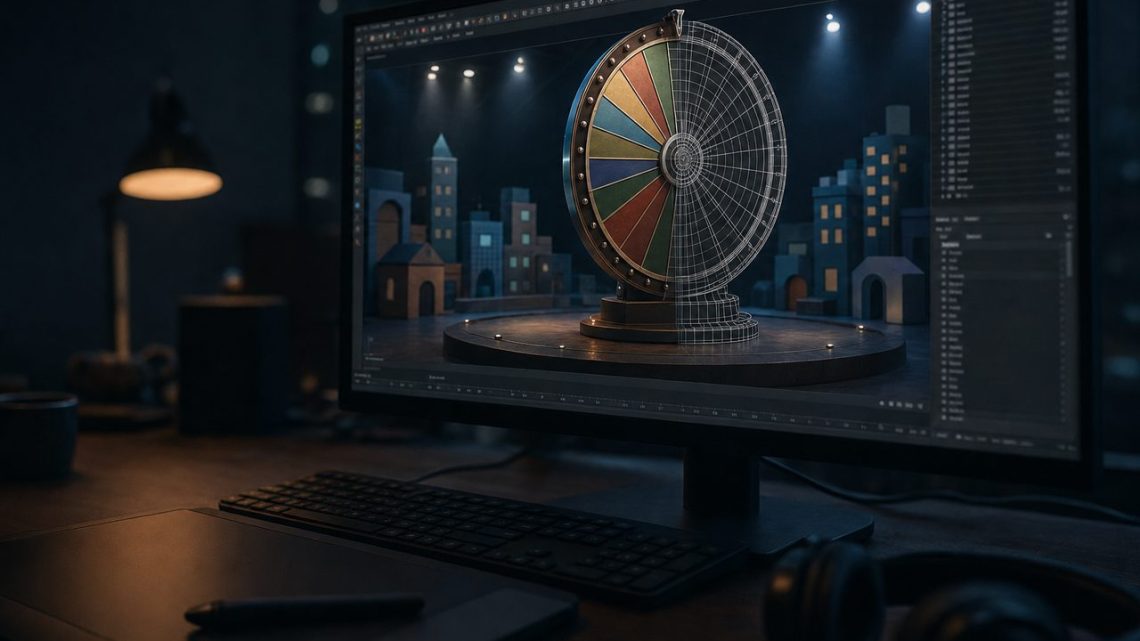
Live Casino Game Shows Are Built Like Video Game Levels
November 25, 2026A presenter spins a giant vertical wheel, it clicks to a stop on a bonus segment, and the studio floor gives way to a cartoon city seen from above. A character in a top hat strides across a board, collecting prizes as he goes. If you build 3D scenes for a living, that cut from camera feed to rendered world is worth a closer look.
Two pipelines running at once
Live-dealer casino games started as plain broadcast television: a real table, real cards, a real dealer and a few cameras. The game-show format added a second layer on top. When Evolution launched MONOPOLY Live in April 2019, it described the game as a special edition of its Dream Catcher money wheel, ‘complete with augmented reality’ and 3D bonus rounds built around MR. MONOPOLY in his own 3D board world.
Crazy Time followed in July 2020, with four bonus spots on its wheel: Cash Hunt, Coin Flip, Pachinko and Crazy Time itself. Each one takes the player out of the studio shot and into a separate scene. So the production has to run a physical set with lights, cameras and a host, and a real-time graphics pipeline that slots into the same broadcast without looking pasted on.
Why the casino lobby now looks like a TV schedule
Game shows have gone from novelty to a standard tab in the live lobby, next to roulette and blackjack. Comparisons of the best UK online casinos now list the number of live tables as a headline feature beside the slot library and the welcome offer, and that tells you how much of the product is now filmed in a studio rather than drawn as a sprite sheet.
For artists, that means a long asset list. Every wheel, set dressing, on-screen graphic and bonus world has to be modelled, textured and lit, then kept consistent across every camera angle a director might cut to.
Lighting a real set so CG can live inside it
The tricky part is making the rendered layer look as if it shares a room with the presenter, and that is ordinary compositing work done under pressure. The colour temperature of the CG key light has to match the studio key, shadows need the same softness and direction, and reflective surfaces such as a chrome wheel rim should pick up something believable from the set around them.
Chroma key adds another wrinkle. Some live casino providers film a dealer in front of a green or blue backdrop, chosen because those colours sit well away from human skin tones, and drop a branded environment in behind them in real time. One physical table can then appear inside several differently styled rooms. Clean edges and controlled colour spill matter more here than in film, because nobody gets to fix a live stream in post.
Rendering on a frame budget
Film VFX can spend minutes or hours on a frame. A live game cannot. At 60 frames per second, each frame has about 16.7 milliseconds to be finished, and at 30 frames per second about 33. Most of the decisions about the 3D assets come back to that number.
Static scenery is a good candidate for baked lighting, so the engine is not working out bounce light it could have stored in a texture. Physically based materials keep metal, felt and plastic consistent under changing light. Level-of-detail models swap in simpler meshes for objects far from the camera, and textures get packed into atlases to cut draw calls. None of that works without tidy UV layouts, which is why our guide to RoadKill UV unwrapping is as relevant to a game-show set as it is to a character model.
Animating a host who is not really there
A 3D mascot in a bonus round has a few seconds to read as a personality. Character animators in console games face the same problem, and the answer is usually strong silhouettes and timing that sells weight. Studios in the wider games industry either keyframe this by hand or record performers on a motion capture stage and clean up the data afterwards, often blending both.
The live presenter and the CG character also have to share a rhythm. The host builds anticipation, the cut lands on the 3D world, and the animation has to pay that moment off without dragging. The craft involved is the same one we described in the phenomenal work of 3D artists in the game industry, just squeezed into a much shorter performance.
Shrinking it all for a phone
Most viewers will watch on a phone screen held upright, so the art has to survive at that size. Small text disappears, fine detail turns to noise under video compression, and a busy background swallows the one number the player needs. Bold shapes and plenty of contrast between the foreground and the set hold up best.
However polished the rendering, it has no effect on the odds. Game shows are gambling products for adults aged 18 and over, and the 3D bonus world is decoration on top of fixed maths. If play stops feeling like entertainment, BeGambleAware and GamCare (0808 8020 133) offer free, confidential support.